

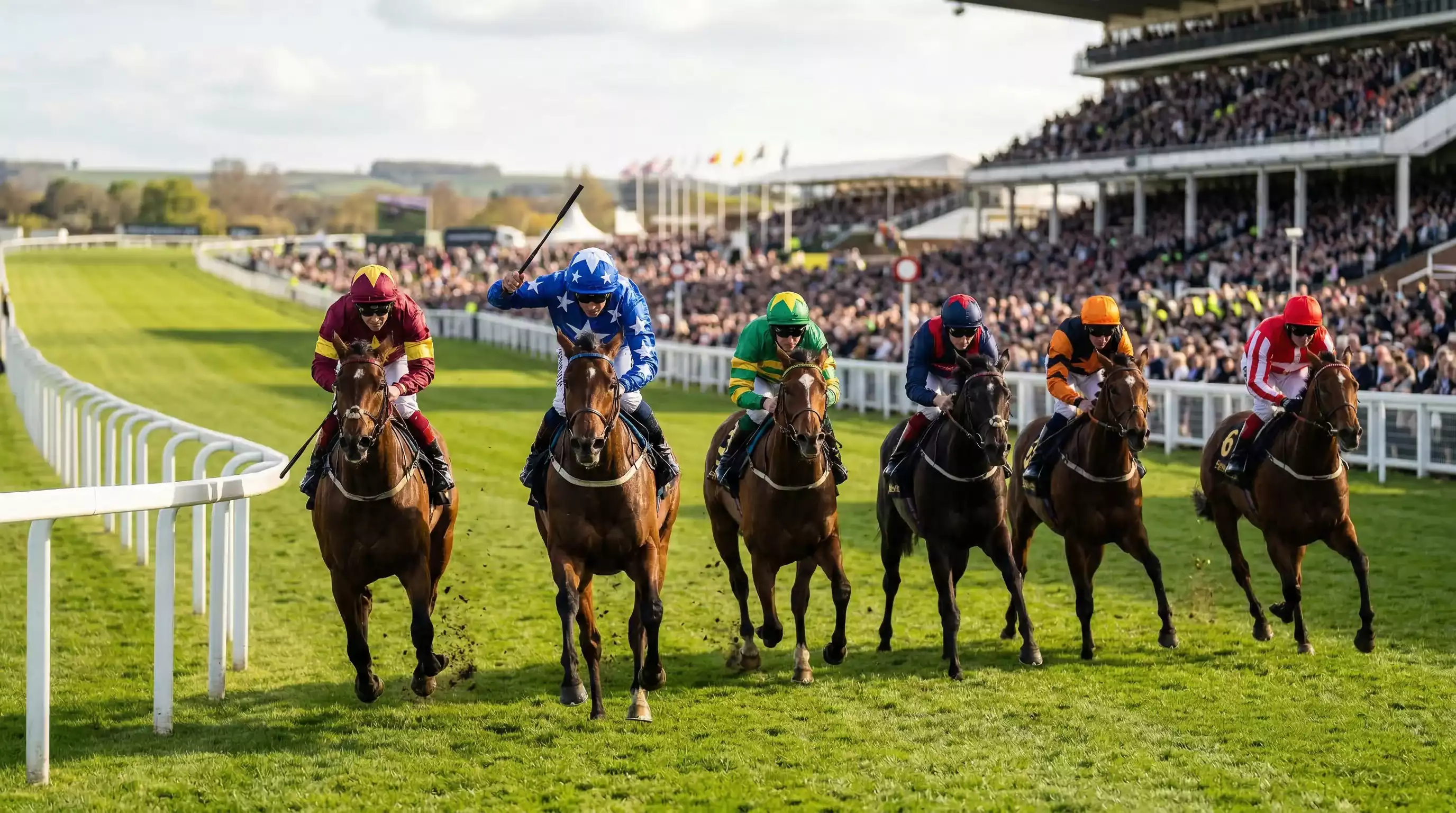
Horse racing is not just Britain's oldest organised sport — it is, by almost any financial measure, the country's second-largest betting medium after football. In the financial year ending March 2025, remote betting on horse racing generated £766.7 million in gross gambling yield for licensed operators, according to the Gambling Commission's Industry Statistics. That figure sits within a total UK gambling market worth an estimated £17.2 billion in 2026, making British racing one of the most financially significant — and tightly regulated — betting environments on the planet.
Yet scale creates its own problems. Hundreds of licensed bookmakers compete for attention. Promotional noise drowns out useful information. And the gap between a well-placed wager and a careless one often comes down to understanding the mechanics: how odds are formed, which bet types suit which scenarios, what separates a trustworthy operator from a flashy newcomer. This guide exists to close that gap. Every claim is pinned to an identifiable source — Gambling Commission filings, BHA reports, HBLB levy data, Treasury policy papers. The aim is not to sell a bookmaker but to build the structural knowledge that turns a casual flutter into a considered decision.
The sport contributes an estimated £4.1 billion annually to the UK economy and supports roughly 85,000 jobs across racecourses, training yards and breeding operations. What follows covers everything from the first principles of placing a bet to the regulatory architecture governing the entire ecosystem. Whether the reader is opening a first bookmaker account or refining a long-standing approach to data-led betting, each section is designed to be useful on its own while building toward a complete picture of UK horse racing betting online.
UK Horse Racing Betting Data: What the Numbers Mean
- Online horse racing betting generates £766.7 million in annual gross gambling yield — Britain's second-largest betting market after football — within a total UK gambling industry worth £17.2 billion.
- The 2025 Budget raised Remote Gaming Duty to 40 percent but explicitly excluded horse racing, leaving racing bets at a 15 percent rate plus the 10 percent Levy.
- More than 80 percent of bets at the 2024 Cheltenham Festival were placed via mobile, and each-way wagers surged 25 percent — making app quality and each-way terms critical when choosing a bookmaker.
- Consistently taking the best available price across multiple licensed operators, using Best Odds Guaranteed, and maintaining bankroll discipline are the three highest-impact habits for long-term racing bettors.
How Online Horse Racing Betting Works in the UK
At its core, the process is straightforward. A bettor selects a horse in a given race, chooses a stake, and either wins or loses depending on the outcome. But the infrastructure beneath that simple transaction is anything but simple. The UK's online betting ecosystem processes billions of pounds through a layered system of odds compilation, risk management, regulatory oversight and automated settlement.
The total UK gambling industry recorded £16.8 billion in gross gambling yield during the financial year 2024–25, a 7.3 percent increase year on year, per the Gambling Commission. Horse racing accounted for £766.7 million of the £2.6 billion remote betting segment — second only to football's £1.3 billion — confirming its status as one of the two pillars on which British bookmaking is built.
How a bet moves through the system: When a punter places a horse racing bet online, the operator's trading desk has already set the odds using form data, market intelligence and algorithmic modelling. Once confirmed, the bookmaker's risk management software adjusts prices in real time. After the race, settlements are automated — winnings appear within seconds, and under UKGC rules, withdrawals must be processed without unreasonable delay.
Every licensed online bookmaker must hold a remote operating licence from the Gambling Commission — a legal requirement under the Gambling Act 2005, extended in 2014 to cover overseas operators serving British customers. The licence imposes obligations around fair terms, responsible gambling tools, anti-money-laundering procedures and the segregation of customer funds.
From the punter's side, placing a bet involves registration with a UKGC-licensed site (identity verification via driving licence or passport required under Know Your Customer rules), depositing funds via debit card, bank transfer or e-wallet, then selecting a race, reviewing odds, choosing a bet type and confirming the stake. The process takes under a minute on a well-designed app, though understanding the choices being made at each step is worth considerably more than speed.
What matters more than speed is understanding the numbers. The odds a bookmaker displays represent their probability assessment plus a built-in margin — the overround — which guarantees a theoretical profit regardless of outcome. Recognising that margin, and knowing when a price looks generous relative to a horse's true chance, is where data-led betting begins. It starts not with a newspaper tip but with an understanding of how the market is structured and who benefits from each transaction within it.
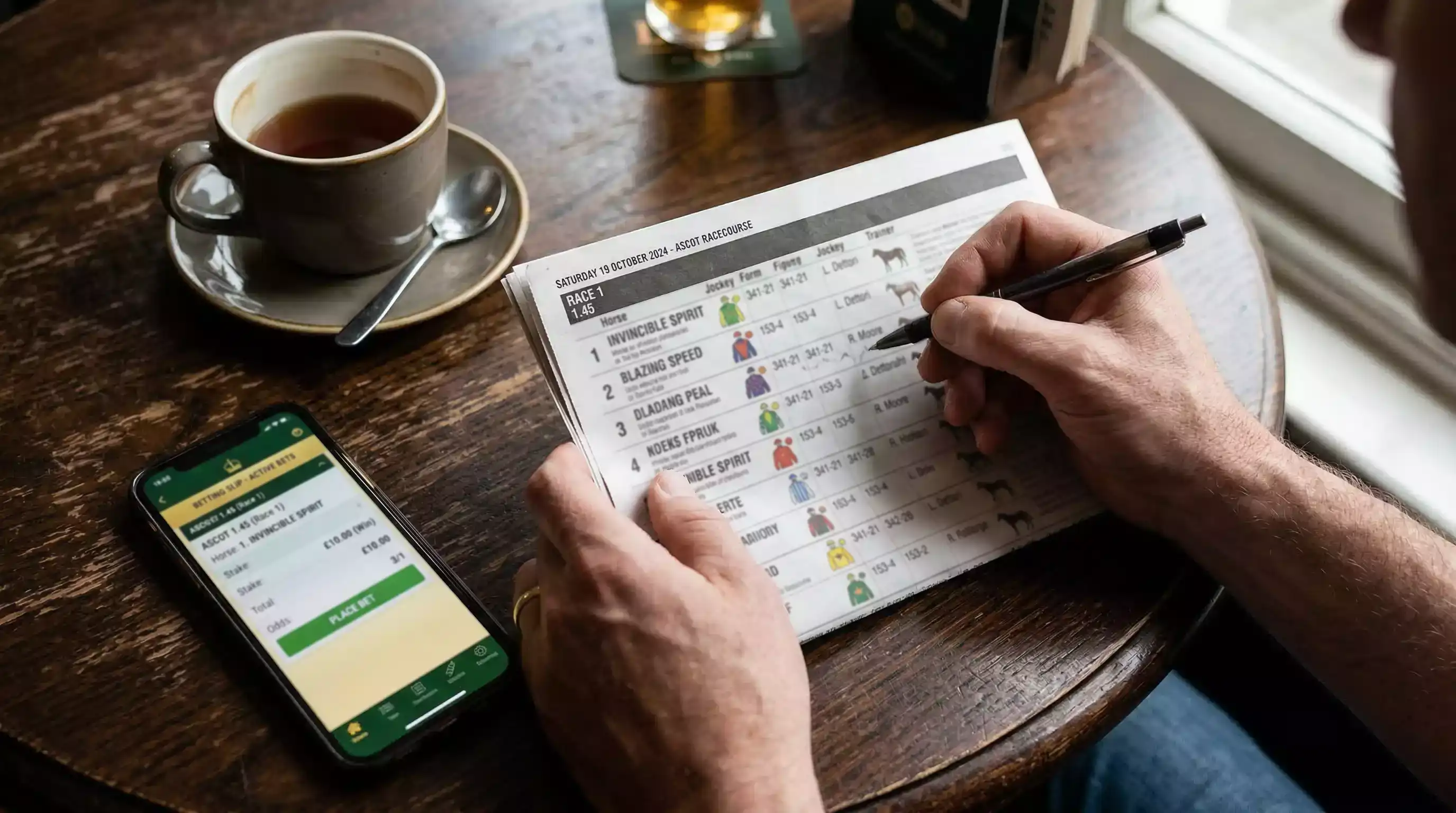
Types of Horse Racing Bets You Can Place
The range of bet types available on UK horse racing is broader than most newcomers expect. The categories below cover the vast majority of wagers placed on British racing.
Win. The most direct bet in racing. Pick a horse, and if it finishes first, the bet pays at the quoted odds. If it finishes anywhere else, the stake is lost. Win bets remain the default for many experienced punters because the maths is transparent, the margin is easiest to calculate, and there are no complications around place terms or fractions. For punters focused on value, win-only betting also produces the clearest signal over time about whether a selection method is working.
Each-way. Two bets in one: a win bet and a place bet. If the horse wins, both pay out. If it finishes in a place position — typically second, third or fourth depending on field size — the place portion pays at a fraction of the win odds, usually one-quarter or one-fifth. Data from Flutter Entertainment showed a 25 percent increase in each-way bets at the 2024 Cheltenham Festival, according to Receptional.
Each-way betting is a distinctly British invention with no direct equivalent in most international markets. In the US, bettors must place separate win, place and show wagers through pari-mutuel pools.
Forecast and tricast. A forecast requires predicting first and second in correct order; a tricast extends to first, second and third. Returns can be substantial from small stakes. Reverse forecasts allow either order but double the stake.
Accumulator. Links multiple selections across different races into a single bet. All must win, with odds multiplied together. A four-fold at average odds of 4/1 per leg produces a potential return of 624/1 — which explains the appeal despite the mathematical improbability. Accumulators generate the biggest payouts from small stakes, but the strike rate is low enough that they are best understood as entertainment rather than strategy. Some bookmakers offer acca insurance — a free bet refund if one leg lets you down — which marginally improves the expected value but does not change the underlying maths.
Ante-post. Bets placed well in advance — days, weeks, sometimes months ahead. They offer longer odds because the bettor accepts extra risk: if the horse is withdrawn, the stake is usually lost. The Cheltenham Festival and Grand National are the biggest ante-post markets in British racing.
Tote pool betting operates alongside fixed-odds bookmakers. Tote bets go into a pool; the dividend depends on total stakes and winning tickets. The Placepot — pick a placed horse in each of the first six races — regularly pays four-figure dividends from a £1 stake.
The key distinction: fixed-odds bets lock in a price at placement; SP bets settle at the starting price; pool bets settle after all money is counted. The smartest punters move between these mechanisms depending on the race and price available.
Understanding Horse Racing Odds
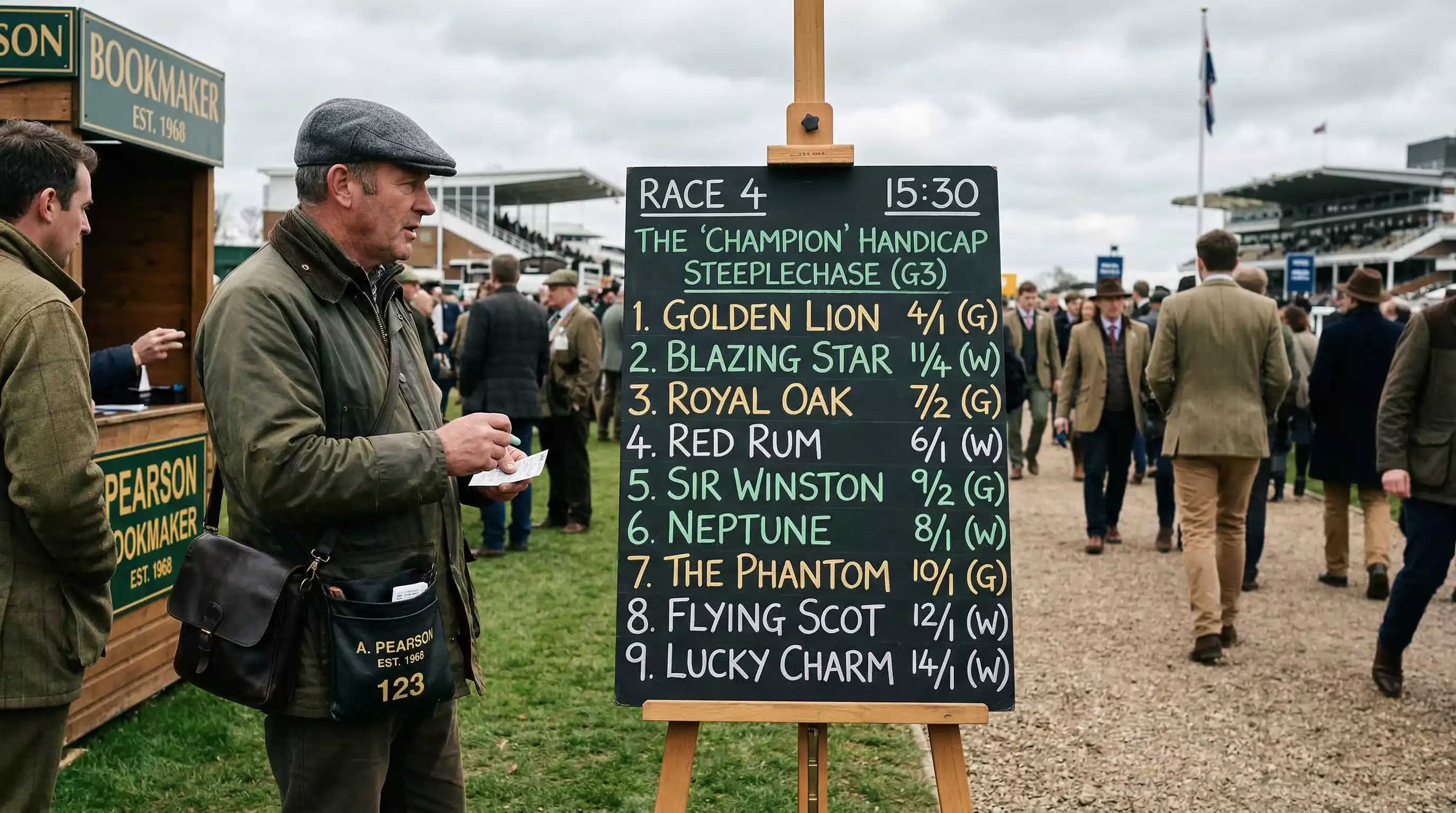
Odds are the language of horse racing betting, and misunderstanding them is the fastest way to make poor decisions. In the UK, three formats coexist: fractional, decimal and the starting price. Each communicates the same underlying information — the implied probability of a horse winning — but they express it differently, and knowing how to read all three is essential for anyone betting regularly.
Fractional odds remain the default on British racecourses and in traditional media. A horse listed at 5/1 returns five pounds of profit for every pound staked, plus the original stake back. At 11/4, it means £11 profit on every £4 wagered. The implied probability of any fractional price is calculated as: denominator divided by the sum of numerator and denominator. So 5/1 implies a 16.7 percent chance of winning; 2/1 implies 33.3 percent; even money (1/1) implies 50 percent.
Decimal odds are increasingly popular on online platforms and are the standard across European betting. A decimal price of 6.00 is equivalent to 5/1; 3.75 equals 11/4. The calculation is simpler: multiply the stake by the decimal number to get the total return, including the stake. If there is one argument for switching to decimal odds, it is that they eliminate the confusion fractional odds create around less intuitive prices like 11/8, 100/30 or 11/10.
Starting Price — the SP is the official price of a horse at the moment the race starts, determined by an independent assessor on course. If a bettor takes SP rather than a fixed price, their return is settled at whatever the market closes at. SP bets are common in each-way multiples and situations where the early price is uncertain, but they remove the punter's ability to lock in a favourable number early.
Behind every quoted price sits the bookmaker's margin. If a three-horse race has true probabilities of 50 percent, 30 percent and 20 percent, the total is 100 percent. But a bookmaker will price the field to sum to, say, 115 percent — that extra 15 percent is the overround, and it represents the operator's theoretical edge. The lower the overround, the better value the market offers. On Premier race days, overrounds tend to be tighter because competition between bookmakers is fiercer and liquidity is higher. On a midweek afternoon card, margins can widen significantly.
This is not abstract. Two bookmakers offering 4/1 and 7/2 on the same horse represent a material difference in expected value. The bettor who consistently takes the better price — through odds-comparison tools, Best Odds Guaranteed promises or exchange markets — gains a measurable mathematical advantage over time. That edge compounds. Over hundreds of bets, it can be the difference between a losing record and a break-even one.
How to Choose a Horse Racing Bookmaker
The number of licensed betting shops has fallen to 5,825 — a 22.8 percent decline since pre-pandemic levels, per the Gambling Commission. That contraction reflects structural migration online. Choosing the right bookmaker from dozens of UKGC-licensed options requires evaluating factors beyond marketing copy.
Odds consistency. The most impactful factor over time. BHA data shows average turnover per race on Premier fixtures rose 1.1 percent in 2025 while Core fixture turnover dropped 8.1 percent — punters gravitate toward better-priced markets. The bookmaker consistently offering a half-point better is worth more than any welcome offer. Odds-comparison tools make checking this straightforward, and the habit of comparing before every bet should become automatic for anyone treating racing as more than a casual pastime.
Best Odds Guaranteed. If a punter takes an early price and the SP is higher, the bookmaker pays the better number. It is a free option on price improvement — there is no downside, and the upside compounds across a full season. Not all operators apply BOG to all meetings or bet types, so reading the small print matters. Some restrict it to single bets, excluding multiples; others cap the maximum improvement. These variations are worth noting.
Market range. A bookmaker pricing up 20 minutes before the off with minimal ante-post coverage is a fundamentally different proposition from one offering markets days in advance with full each-way terms on handicaps and non-handicaps. For punters who like to take early positions — particularly in the weeks before major festivals — deep ante-post coverage is essential, not optional.
UKGC licence — non-negotiable. Every operator serving UK residents must hold a Gambling Commission licence, guaranteeing fair-play rules, fund protection and a formal complaints process. The register is public and searchable. There is no good reason to bet with an unlicensed operator, regardless of what promotional inducements they offer.
Compare odds on ten races across different tiers — Premier, Core and an evening card. Track which operator consistently offers the best price. That exercise tells you more than any review site.
Withdrawal speed and payment methods. Deposits are instant via debit card at all major operators. Withdrawals vary considerably — some process within 24 hours, others take up to five business days. E-wallet options tend to be faster. Minimum withdrawal thresholds and any associated fees differ between bookmakers and are worth checking before committing to a primary operator.
UK Horse Racing Betting Sites Compared
Comparing bookmakers on racing requires looking beyond branding into the features that directly affect returns. No single site dominates every category — the best choice depends on what the individual bettor prioritises. The table below sets out the key criteria across established UKGC-licensed operators with a meaningful horse racing presence.
| Feature | What to look for | Why it matters |
|---|---|---|
| Best Odds Guaranteed | Available on UK and Irish racing; covers each-way bets | Free price improvement — the single most valuable feature for regular racing bettors |
| Live streaming | UK, Irish and international coverage; accessible with a funded account or placed bet | Essential for in-play betting and live form tracking |
| Cash out | Full and partial options; available pre-race and in-play | Lock in profit or cut losses — particularly useful on ante-post wagers |
| Early prices | Markets priced the day before or morning of race, not just 15 minutes before | Time to compare, find value and take a position before the market tightens |
| Each-way terms | Places paid and fraction of odds; enhanced place terms on handicaps | Generous each-way terms on big-field races materially increase long-term returns |
| Ante-post range | Markets available weeks or months ahead on major festivals and Classics | Deep ante-post coverage for exploiting early value before the market adjusts |
Among established operators, structural distinctions are worth understanding. The Tote operates pool betting rather than fixed odds — its Placepot and Jackpot pools offer a fundamentally different risk-reward profile to anything available from traditional bookmakers. Betting exchanges like Betfair Exchange allow punters to back and lay horses, effectively trading positions during a race, with commission charged on net winnings rather than a margin baked into the price. These are not just different brands operating the same model — they are different models entirely, and each has strategic applications depending on the bettor's style and objectives.
For fixed-odds bookmakers, the most measurable differentiator remains odds quality. Operators that price aggressively to attract sharp racing bettors tend to offer tighter overrounds, meaning better value for the customer. Operators relying on recreational volume may compensate with more generous promotions, loyalty schemes or enhanced place terms on festival days. Neither approach is inherently superior — it depends on whether the bettor values consistent edge or periodic bonuses.
One increasingly important variable is how bookmakers treat winning customers. The practice of restricting accounts — limiting stakes or closing accounts entirely — for punters who win consistently is widespread and technically legal under current UKGC rules, though the Commission has signalled interest in reviewing the practice. For punters who expect to generate sustained returns, exchange betting or Tote pools are structurally better options because they do not rely on the bookmaker's willingness to accept the bet at the requested stake.
No single bookmaker offers the best odds on every race. Holding accounts with three or four UKGC-licensed operators and comparing prices before each bet is the closest thing to a free edge in racing.

Free Bets, Welcome Offers and Promotions
Almost every UKGC-licensed bookmaker offers some form of incentive to new customers, and understanding the mechanics behind these offers is the difference between using them wisely and losing money on them.
Welcome offers generally follow one of three structures. The most common is a matched free bet: the customer places a qualifying bet with real money, and on settlement the bookmaker credits a free bet token of equivalent or greater value. The second variant is a risk-free first bet, where the stake is refunded as a free bet if the qualifying wager loses. The third, less common, is a deposit bonus — a percentage of the first deposit added as bonus funds, usually with turnover requirements before withdrawal is permitted.
The critical detail in all three cases is the wagering requirement. A free bet token rarely works the same way as cash. In most cases, only the profit from a free bet is returned — the "stake" portion of the token is not included in the payout. So a £20 free bet placed at 3/1 returns £60 in profit, not £80. This distinction costs real money and is overlooked by a remarkable number of bettors.
Stake-not-returned vs. stake-returned: The majority of UK bookmaker free bets operate on a stake-not-returned basis. If a bookmaker offers a stake-returned free bet, it will be explicitly stated in the terms — and it is significantly more valuable. Always check which type applies before calculating expected value from any promotional offer.
Ongoing racing promotions are often more valuable than welcome offers for bettors who bet regularly. These include Best Odds Guaranteed, extra places on selected handicaps, accumulator insurance on multiples, and money-back specials if a selection finishes second to the favourite. The value of BOG alone, compounded over a full season of racing, almost certainly exceeds the value of any one-off sign-up offer — which is why odds quality and feature set should always take priority over the headline promotional figure.
Some promotions are genuinely useful; others are designed to encourage higher-risk betting behaviour. A free bet on a four-fold accumulator sounds generous, but it steers the customer toward a bet type with a success rate measured in single digits. BOG, by contrast, improves the expected value of every qualifying bet the punter would have placed anyway. The distinction between value-adding and behaviour-shaping promotions is worth keeping in mind.
Live Streaming and Race Coverage Online
The ability to watch horse racing live while betting on it has shifted from a premium feature to an expected baseline. Every major UK bookmaker now offers streaming, typically to customers who have placed a bet on the race or hold a funded account. The practical value is considerable — watching a horse in the parade ring, observing how it travels to post and tracking pace in real time all feed into sharper decisions, especially for in-play bettors who need to react to how a race is unfolding.
Streaming coverage falls into two categories. First, bookmaker-hosted streams delivered through media rights agreements with racecourses and racing media companies. These cover the majority of UK and Irish fixtures — often 30 or more races per day — and are accessible directly within the bookmaker's website or app. Second, terrestrial and digital broadcasts, most notably ITV Racing, which holds the free-to-air rights for major fixtures including the Cheltenham Festival, Grand National, Royal Ascot and Champions Day until 2030.
Stream quality varies between operators. Some deliver HD video with minimal latency; others offer a feed that sits several seconds behind the course broadcast. For punters who trade in-play — entering or exiting positions during a race — even a one-to-two-second delay can be costly. Testing the stream at different operators before committing to one as a primary platform is worth the effort.
The 2025 Grand National was broadcast to an estimated 600 million viewers worldwide across 32 international feeds spanning six continents — one of the most-watched individual horse races on the planet.
Beyond live footage, some operators offer enhanced data overlays during streams — sectional timing, in-running prices and commentary integration. Sectional times reveal how fast a horse is travelling at different stages of a race, which can confirm or contradict the visual impression. For form-analysis purposes, streamed races with sectional data are a more reliable input than replays viewed after the fact.
Mobile Betting — Placing Bets on the Go
The smartphone has fundamentally reshaped how people bet on horse racing. Data from the 2024 Cheltenham Festival showed more than 80 percent of bets were placed via mobile, per Receptional's analysis of Flutter platform figures. Desktop is now the minority channel for horse racing betting in the UK, and bookmaker product development reflects that reality.
A well-built racing app should deliver three things quickly: access to racecards and form data, the ability to place and manage bets with minimal taps, and live streaming within the same interface. The best apps integrate all three seamlessly, allowing a punter to study the card, watch the parade ring, place a bet and follow the race — all without switching platforms. Apps that force users to separate streaming pages or bury the racecard behind multiple menus create friction, and friction costs time in a market that moves fast.
Push notifications are a double-edged feature. Used well, they alert a bettor to non-runner changes, significant odds movements or the start of a race with a pending bet. Used badly, they become a stream of promotional noise encouraging impulsive wagers. Most apps allow notification settings to be customised — turning off promotional alerts while keeping race-relevant ones is a sensible configuration for anyone who wants information without distraction.
Evaluate racing apps on three criteria: speed to bet placement, quality of integrated live streaming, and how cleanly form data is presented. Everything else is secondary.
One practical consideration that is often overlooked: battery life and data usage. Live streaming a full afternoon of racing consumes significant mobile data and drains battery fast. If betting at the racecourse via mobile — something an increasing number of on-course punters do, bypassing the Tote queues — a portable charger is not a luxury but a tool of the trade.
Betting Strategies for UK Horse Racing
Strategy in horse racing betting is not about finding a system that guarantees profits — no such system exists. It is about tilting the odds in your favour through discipline, information and a clear understanding of value. The approaches below are not mutually exclusive; most experienced punters combine several.
Value betting. The core principle: back horses at odds longer than their true probability justifies. If a horse has a 25 percent chance of winning (implied odds 3/1) and the bookmaker offers 4/1, that bet has positive expected value. The challenge is making accurate probability assessments — and being honest when you cannot. Value betting requires systematic form analysis, not a gut feeling dressed up in pseudomathematical language. Building a ratings model, even a simple one, and comparing its output to the market price is a more reliable path than following tips.
Bankroll management. The most common reason punters who can identify value still lose money is poor staking. Level stakes — betting the same amount on every selection — is the simplest approach and the one most resistant to emotional decision-making. Percentage-of-bank staking, where the size adjusts as the bankroll grows or shrinks, is more sophisticated but requires discipline. What matters is having a defined method and sticking to it regardless of recent results. The BHA's 2025 Racing Report noted betting turnover on British racing fell 4.3 percent in 2025, continuing a 10.3 percent decline since 2023 — a reminder the market is not easy money for anyone, including the operators.
Specialisation. Attempting to bet on every race at every meeting is a recipe for mediocrity. Punters who specialise — in a particular course, a distance range, a trainer's yard, or a specific type of race like two-mile handicap hurdles — develop pattern recognition that generalists simply cannot match. Specialisation also makes record-keeping manageable and long-term analysis meaningful.
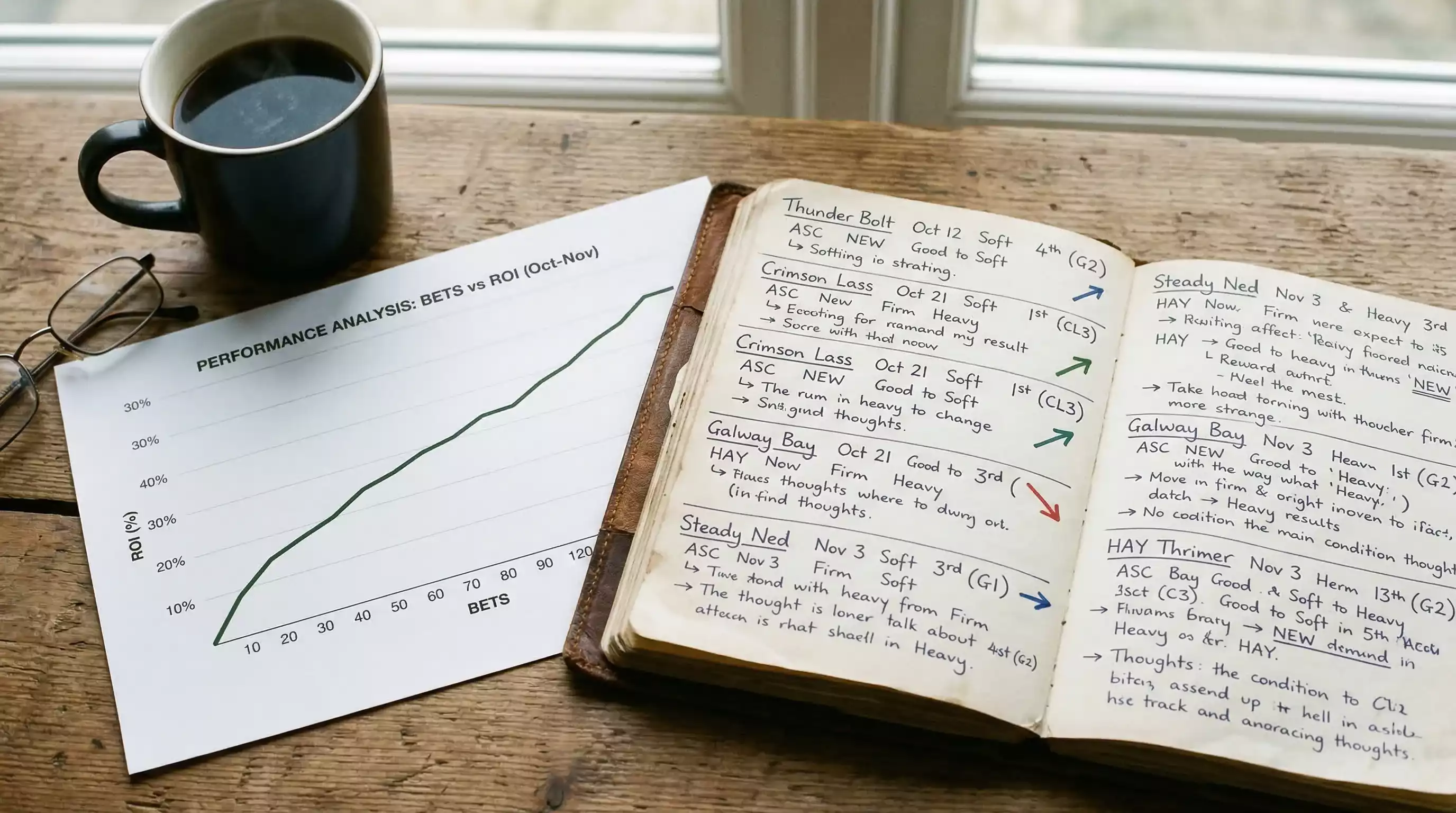
Form cycles and going preference are two of the most underrated analytical tools. A horse that performs best on soft ground in the autumn will show a form profile that looks inconsistent to a casual observer but is perfectly logical once the going is factored in. Similarly, horses returning from a break often need a run to reach peak fitness, and understanding these cycles separates informed betting from guesswork.
Race-day discipline. Not every race is worth betting on. A competitive nine-runner handicap with a clear front-runner bias and soft ground may present a strong value opportunity. A twelve-runner maiden at a Monday evening meeting with no exposed form may be effectively random. The willingness to sit out races — to treat inaction as a valid strategic choice — is one of the hardest skills for any bettor to develop and one of the most important.
Data-led betting does not mean reducing every decision to a spreadsheet. It means using available information — official form, going reports, trainer statistics, sectional times, market movements — to inform decisions rather than relying on instinct alone. The data is more accessible now than at any point in racing history.
Major UK Horse Racing Events Every Bettor Should Know
The British racing calendar runs year-round, but the betting market's centre of gravity shifts decisively through a handful of marquee fixtures. Understanding the calendar is not just about knowing when races happen — it is about knowing when the deepest, most competitive markets form, because that is where the best value typically exists.
The year begins with the National Hunt season in full swing. The Cheltenham Festival in March remains the single largest betting event in Jump racing, with William Hill projecting a turnover of approximately £450 million across the four days of the 2026 Festival. Twenty-eight championship races over Tuesday to Friday attract the best-trained horses from Britain and Ireland, with the Champion Hurdle, Queen Mother Champion Chase, Stayers' Hurdle and Gold Cup serving as the defining tests of each division. The ante-post market for Cheltenham is the most liquid in Jump racing, and prices begin to form months before the first race.
Three weeks after Cheltenham, the Grand National at Aintree draws an audience that extends far beyond regular racing followers. Betting turnover on the National alone has been estimated at over £200 million, and the race's global reach — broadcast across six continents to an estimated 600 million viewers — makes it one of the most-watched sporting events in Britain. For once-a-year punters, the National is the gateway; for regulars, it represents the final peak of the Jump season before the Flat takes over.
The Flat season opens in earnest with the Guineas Festival at Newmarket in early May, followed by the Epsom Derby and Oaks in June — the first two legs of the Classic series that defines the three-year-old generation. Royal Ascot, held across five days in June, is the Flat calendar's equivalent of Cheltenham: a festival-format meeting with championship-calibre racing, massive betting turnover and global media coverage. The Glorious Goodwood Festival in late July and York's Ebor Meeting in August round out the summer's major fixtures.
In the autumn, British-trained runners often contest the Prix de l'Arc de Triomphe at Longchamp before the domestic season concludes with Champions Day at Ascot in October — a fixture concentrating the Flat's end-of-season championship races into a single card. The Jump season then returns, cycling toward winter festivals at Kempton (King George VI Chase, Boxing Day) and beyond.
Across 2025, total racecourse attendance reached 5.031 million — the first time the five-million threshold had been crossed since 2019, representing a 4.8 percent rise on the previous year. Prize money hit a record £194.7 million, up 3.5 percent, with racecourse contributions accounting for £103.4 million of the total, according to the BHA's 2025 Racing Report. The growth in under-18 attendance — 211,447, a 17 percent increase — suggests the audience is broadening, not just stabilising.
"There was much to be pleased about in 2025. Our major meetings and races performed strongly. Of course, there are challenges with the horse population continuing to decline and the betting environment remaining a challenging one." — Richard Wayman, Director of Racing, British Horseracing Authority
Every single one of the 28 races at the 2025 Cheltenham Festival finished inside the season's top 31 by betting turnover — a concentration of market activity unmatched by any other fixture in British racing.
For bettors, the calendar creates a rhythm of preparation. Ante-post markets for Cheltenham and the Guineas form months ahead. The summer's big handicaps reward early form analysis. And the transition periods between Flat and Jump, where dual-purpose horses switch codes, can produce overlooked opportunities for those paying attention.
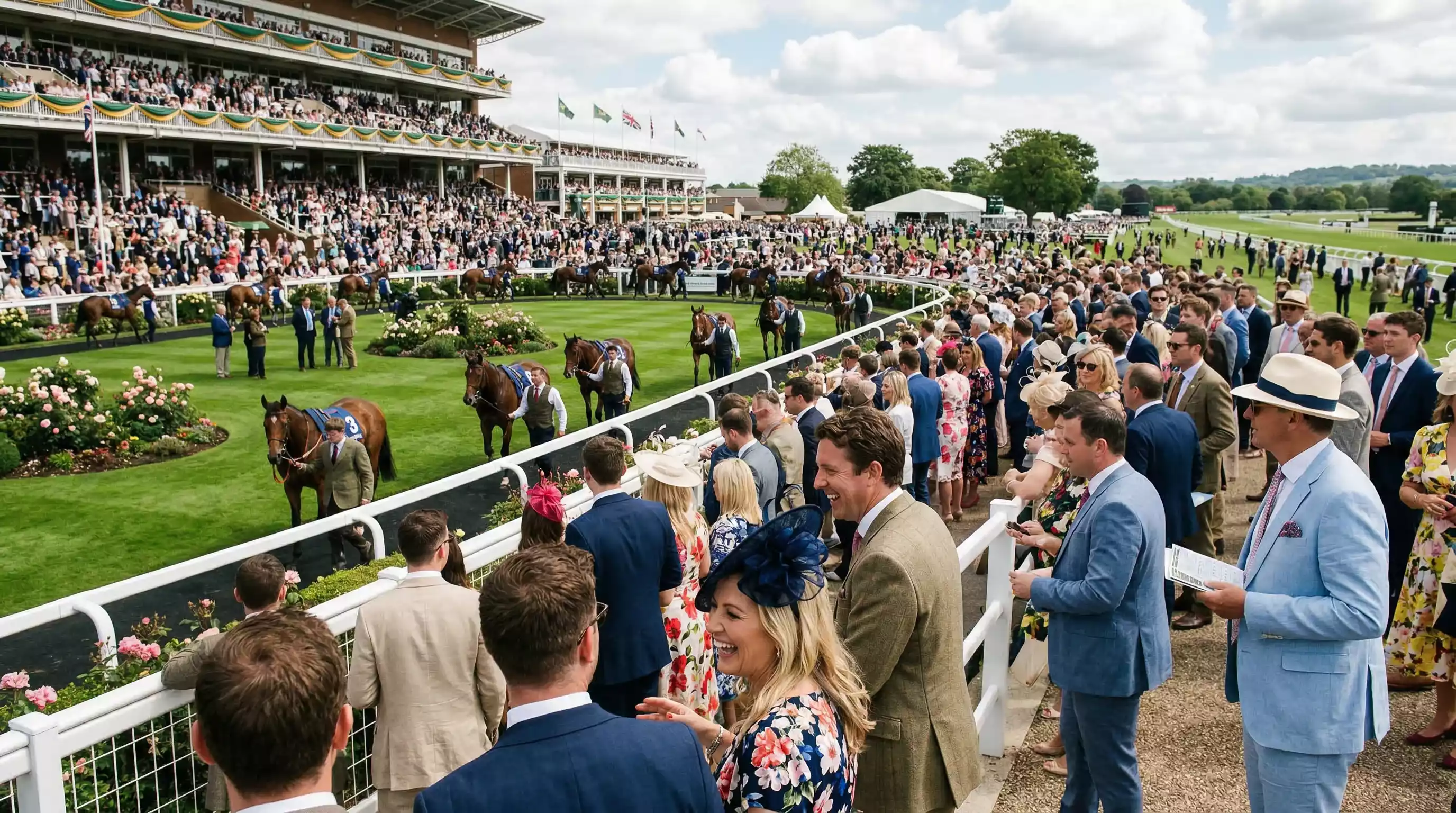
UKGC Regulation, Levy and the Tax Landscape
The UK operates arguably the most comprehensive gambling regulatory framework in the world, and any guide to horse racing betting online that does not explain it is incomplete. The system rests on three pillars: the Gambling Commission's licensing regime, the Horserace Betting Levy, and the tax structure that funds both public revenue and sport reinvestment.
The UKGC licensing regime. The UK Gambling Commission licenses and regulates all commercial gambling in Great Britain under the Gambling Act 2005. Every operator — whether headquartered in London, Gibraltar or Malta — must hold a remote operating licence to legally offer betting services to UK customers. The Commission's register is public and searchable, meaning any bettor can verify a bookmaker's licence status in seconds. Operators that fail to meet their licence conditions face enforcement action: in recent years the Commission has levied multi-million-pound regulatory settlements and revoked licences from operators found to have failed on anti-money-laundering or social responsibility grounds.
The Horserace Betting Levy. Unique to British racing, the Levy requires all bookmakers earning revenue from bets on British horse racing to pay 10 percent of their gross profits on those bets to the Horserace Betting Levy Board. Since the 2017 reform, which extended the Levy to cover offshore operators, income has risen substantially. In the financial year ending March 2025, Levy income reached a record £108.9 million — the fourth consecutive year of growth and the highest total since the reform took effect, as reported in the HBLB Annual Report 2024–25. That money flows back into the sport through prize money contributions, veterinary science funding, racecourse improvements and integrity services — the mechanism by which betting funds the sport it depends on.
The 2025 Budget and gambling duty reform. The Autumn Budget delivered by Chancellor Rachel Reeves in November 2025 reshaped the tax landscape for British gambling. The headline changes: Remote Gaming Duty rises from 21 percent to 40 percent, effective. A new remote betting rate of 25 percent within General Betting Duty takes effect from 1 April 2027. Critically for racing, online bets on British horse racing were excluded from the increase and remain taxed at 15 percent — a decision the government attributed to the "unique circumstances" of the racing industry, where the Levy already adds a further 10 percent, creating a de-facto combined rate of 25 percent on racing bets.
"Remote gaming is associated with the highest levels of harm and so I am increasing Remote Gaming Duty from 21% to 40%. I am making no change to the taxes on in-person gambling or on horse racing." — Rachel Reeves, Chancellor of the Exchequer, Budget 2025
The fiscal impact is significant. The House of Commons Library estimates the combined reforms will generate £810 million in additional revenue in 2026/27, rising to £1.16 billion by 2030/31. For bookmakers, the higher remote gaming duty squeezes margins on casino products; for racing, the exemption came with relief but no additional government funding for the sport itself.
The black market. Research by Yield Sec estimated that unlicensed operators controlled nine percent of the UK's online gambling market, generating approximately £379 million in GGY during the first half of 2025 alone — up from less than half a percent in 2020. Separately, a BGC-commissioned study put annual unlicensed online wagering at around £2.7 billion. These figures highlight a core tension in UK gambling policy: stricter regulation of licensed operators can push some bettors toward unregulated sites offering none of the protections the UKGC framework provides.
Interactive Tool
Budget Revenue Growth Multiplier, and Racecourse Prize Money Share
Calculate the exact growth multiplier of the 2025 Budget's tax revenue, and what share of BHA prize money comes from racecourses.
Growth Multiplier
-
-
2026/27
-
2030/31
-
Growth
-
What this guide gives as two figures without the multiplier: "the combined reforms will generate £810 million in additional revenue in 2026/27, rising to £1.16 billion by 2030/31." The growth multiplier is never calculated — it's 1.43x, an increase of +43.2%.
Racecourse Share
-
Racecourse Contribution
-
Total Prize Money
-
Other Sources
-
What this guide gives as two figures without the share: "Prize money hit a record £194.7 million, up 3.5 percent, with racecourse contributions accounting for £103.4 million of the total." The share is never calculated — racecourses fund 53.1% of total prize money, with the remaining £91.3 million coming from other sources.
The regulatory architecture around UK horse racing betting is designed to protect bettors and fund the sport simultaneously. Understanding the Levy, the duty structure and the UKGC's role is not just academic — it affects which operators are safe to use, why certain products are taxed differently, and why the industry's economics look the way they do.
Responsible Gambling — Facts, Tools and Support
Any guide that discusses the mechanics of betting without addressing its risks is doing its readers a disservice. The data on gambling harm in the UK is not ambiguous, and understanding it is part of being an informed bettor.
According to the Gambling Survey for Great Britain, Wave 2, published in 2025, 48 percent of UK adults had participated in some form of gambling in the preceding four weeks, with 28 percent doing so if the National Lottery is excluded. Seven percent reported betting on horse racing — a notable increase from four percent in the previous survey wave, reflecting both growing engagement and the accessibility of online platforms.
The more sobering figure comes from the GSGB's annual report for 2024: 2.7 percent of adults scored eight or more on the Problem Gambling Severity Index, the threshold for classification as a problem gambler. That extrapolates to approximately 1.4 million people. A further 3.1 percent — around 1.6 million — fell into the moderate-risk category with PGSI scores of 3 to 7. These are not abstractions; they represent real people experiencing real harm.
"The Gambling Survey for Great Britain is a key building block of the evidence base which helps government, industry and other partners understand both gambling behaviour and potential consequences from gambling." — Andrew Rhodes, Chief Executive, UK Gambling Commission
Tools available to bettors. Every UKGC-licensed operator is required to offer a suite of responsible gambling tools. These include deposit limits (daily, weekly or monthly caps), loss limits, session time reminders, cooling-off periods and self-exclusion. GAMSTOP, the national online self-exclusion scheme, allows a single registration to block access across all UKGC-licensed gambling sites for six months, one year or five years.
Since February 2025, the Gambling Commission has implemented financial vulnerability checks with a trigger threshold of £150 per month in net deposits. The measure is controversial — a BHA-commissioned survey found that 52 percent of respondents said they would reduce or stop betting entirely if subjected to intrusive financial checks — but the Commission has argued the checks are necessary to prevent harm.
Where to get help: GamCare (0808 8020 133) provides free support and counselling for anyone affected by gambling. The National Gambling Helpline is available 24/7. BeGambleAware.org offers self-assessment tools and referral pathways for individuals and families.
For horse racing bettors specifically, the interplay between the excitement of the sport and the mechanics of betting can blur the line between enjoyment and compulsion. Using deposit limits proactively, maintaining a dedicated bankroll separate from household finances, and tracking bets systematically are the habits of punters who remain in control over time.
Frequently Asked Questions
Is online horse racing betting legal in the UK?
Yes. Online horse racing betting is fully legal in the United Kingdom, provided you use an operator licensed by the UK Gambling Commission. The Gambling Act 2005, amended by the Gambling Act 2014, establishes the legal framework for all commercial gambling in Great Britain, including remote betting. Under this framework, any operator offering betting services to UK customers — regardless of where the operator is based — must hold a valid UKGC remote operating licence. The Commission maintains a public register that allows you to verify any bookmaker's licence status. Using an unlicensed site is not illegal for the bettor, but it removes all regulatory protections: there is no guarantee of fair terms, no obligation to segregate your funds, and no access to the Commission's complaints process. Stick to licensed operators.
Do you pay tax on horse racing betting winnings in the UK?
No. In the UK, bettors pay no tax on their gambling winnings. The tax burden falls entirely on the bookmaker through General Betting Duty and, for horse racing specifically, the Horserace Betting Levy. Since October 2001, when the government abolished betting duty for punters, all taxes on gambling have been shifted to the operator side. For online horse racing bets, bookmakers currently pay 15 percent of their gross profits as General Betting Duty, plus 10 percent of gross profits on British racing through the Levy — a combined effective rate of 25 percent. The 2025 Budget raised Remote Gaming Duty to 40 percent but explicitly excluded horse racing from the increase. Your winnings, whether from a £2 each-way or a five-figure accumulator, are yours to keep in full.
What is Best Odds Guaranteed and why does it matter?
Best Odds Guaranteed — commonly abbreviated to BOG — is a feature offered by most major UK bookmakers on horse racing. It works like this: if you take an early price on a horse and the starting price when the race begins is higher, the bookmaker pays you out at the better price. For example, if you back a horse at 5/1 in the morning and the SP drifts to 7/1, a BOG bookmaker will settle your bet at 7/1. If the SP is shorter — say 4/1 — you keep your original 5/1. In practical terms, BOG is a free option on price improvement. Over a full season of regular racing bets, the cumulative value of BOG can easily exceed the value of any single welcome offer. Not all bookmakers offer BOG on every meeting or every bet type, so checking the terms is important. But any serious racing bettor should prioritise operators that offer it as standard on UK and Irish racing.
